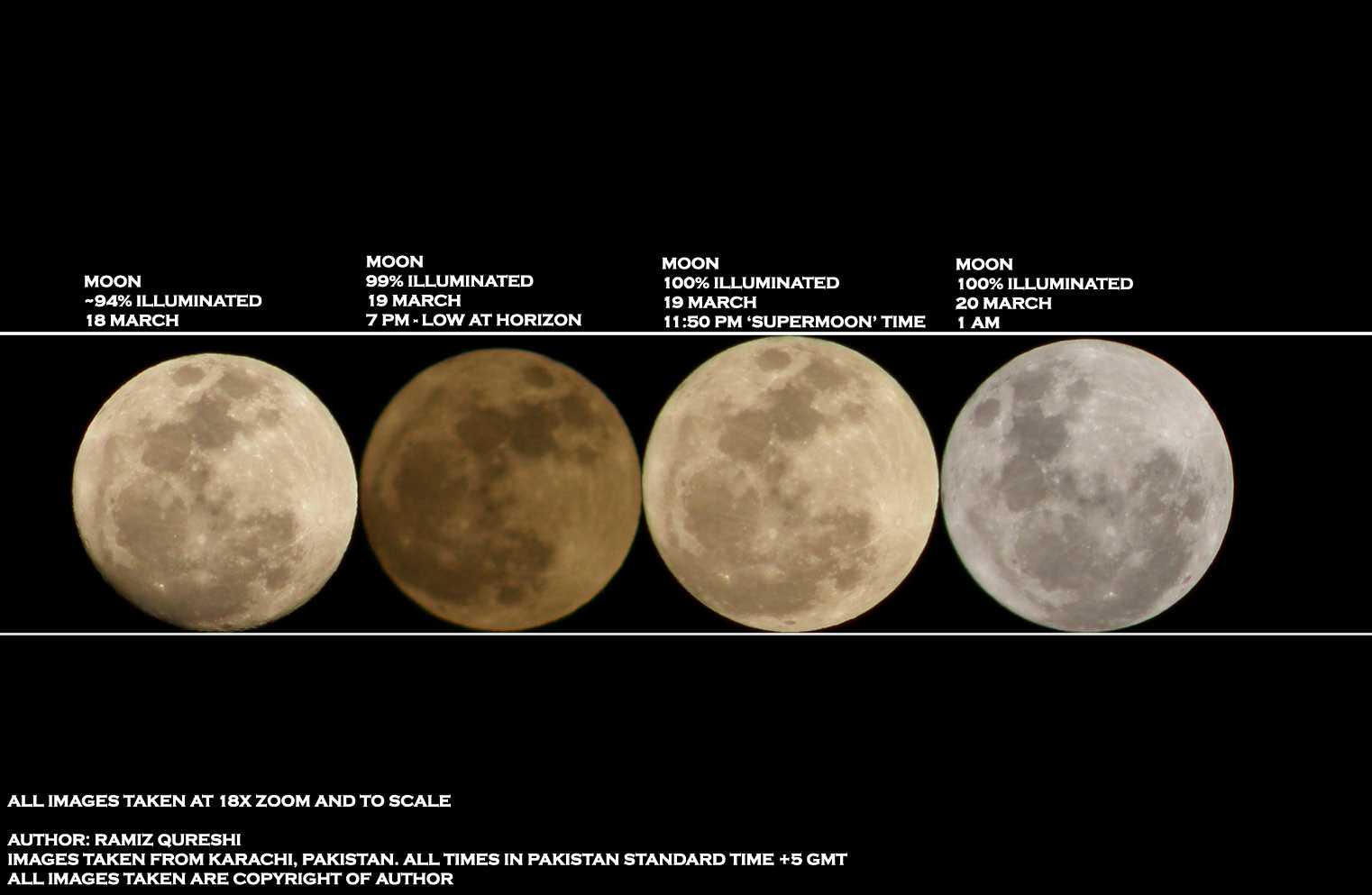
If it seems slightly brighter out tonight than other nights, you're not imaging things.
Moonlight has been the subject of many a romance-writer's pen, has been used to illuminate the gruesomeness of classic B-Movie horrors, and been used by many of of us to light our way from an outing under the stars.
But tonight's moon will be brighter, and it has nothing to do with romance, horror or finding one's way home -- though these things may occur tonight regardless of tonight's supermoon.
Astronomers define a 'supermoon' as occuring when the moon's orbit is closest to our Earth's, making it appear bigger, brighter and all the more alluring in the night's sky.
The moon's actual diameter won't really change -- well slightly if you account for gravitational pulls between our planet and itself -- but tonight's supermoon will be at its most visible to all of us, with or without telescopes or other star gazing aids.
Tonight's full moon, weather permitting, will appear between 14 to 30 percent brighter than previous full moon's, depending upon where you happen to be during the ideal viewing time for tonight's supermoon of about 11:35pm EST -- that's just after the giant sphere above hits it's perigee.
When the moon hits perigee, it will be at it's closest orbit to the Earth -- the scientific name for a supermoon is a "perigee moon" -- meaning our moon will be about 221, 802 miles, or 356, 955 kilometers from the Earth. That's about 12.2 percent closer to us than when the moon is at apogee -- it's furthest point from our planet. On average, the moon is about 230,000 miles or 384,000 kilometers from the Earth.
Also of special note, meteors from Halley's Comet will be visible tonight too -- making tonight's skyviewing exceptionally amazing for astronomers, and those of us just out and about.
Viewing Tonight's Supermoon
While you're out and about, here are some quick tips so you can easily catch a glimpse of some of the wildness occurring in the space above:
- For best viewing, start to watch at moonrise or moonset. The moon will appear larger as it is higher in the sky. You can find the these times in the farmer's almanac.
- Get as far away from major urban centers as possible. Lights from the city obstruct and interfere with star gazing in general. Although the moon will still be visible in the city, you'll have a better view outside the city.
- Lie flat on your back. You might want to toss down an old blanket, sleeping bag or lawn chair first! But by lying on your back, you're eyes will have a wider field of view, so you'll see more of the night's sky.
- Earlier is better than later. It takes our eyes on average about 30 minutes to adjust to variances in light conditions around us. So, get to your chosen viewing spot about a half-hour before you begin viewing, so that your eyes are already adjusted to the darkness around you.
- Be patient. Star gazing doesn't happen at warp speed, the process of moonrise to moonset takes a slow, and gradual period of time. And the meteor shower will also happen at it's own pace -- although the meteors will be screaming through space, if you're looking anywhere but up, you'll miss 'em. Relax, take your time, and enjoy the show.

No comments:
Post a Comment
Thank you kindly for your feedback! All comments are reviewed prior to posting.