Last week, one of Canada’s large national newspapers
announced that it will start charging readers for it’s online editions.

The Globe and Mail said it will allow readers to view a
as-yet-undetermined amount of stories online, and then afterwards force them to
subscribe to the paper to continue reading.
They are taking a page from the American New York Times,
which has been charging online readers for their stories.
Wait a sec . . . wasn’t print declared dead long ago?
 A recent study on the best and worst 200 jobs to have cited ‘newspaper
reporter’ as one of the top 10 worst jobs to have, because of declining readers,
and consequently a lack of jobs. The article mentions how most people get their
news from the Internet and then television or radio, often not having time to
read a full newspaper.
A recent study on the best and worst 200 jobs to have cited ‘newspaper
reporter’ as one of the top 10 worst jobs to have, because of declining readers,
and consequently a lack of jobs. The article mentions how most people get their
news from the Internet and then television or radio, often not having time to
read a full newspaper.
Many newspapers across the globe have simply closed their
doors, sending their reporters scattering looking for work, because of this
decline in readership, due in large part to other free sources of instant news
online.
So what were the editors at The Globe and Mail thinking when
they thought they could build a revenue stream off the backs of their already
declining readership?
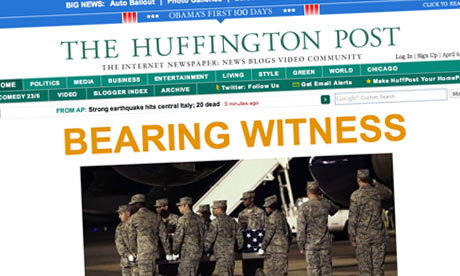
Look to the other end of the digital spectrum to see The Huffington Post, the world’s largest and most respected completely online – and
FREE – newspaper. This online source for news and information has quickly
become an enormous success for founding publisher Arianna Huffington. Yet she’s
giving away her product free.
Will Canada’s Globe and Mail, one of the oldest papers in
Canada, which was the last true broadsheet paper until newsprint costs cut
column inches, survive by charging for what others give away for nilche?
 Granted, newspapers, magazines and other subscription-based
services will always have their dedicated customer niches, which, if they have
the money to burn, will.
Granted, newspapers, magazines and other subscription-based
services will always have their dedicated customer niches, which, if they have
the money to burn, will.
However, as the global economy continues to fail, jobs
continue to decrease, and the cost of living continues to rise, the disposable
income those niche customers have to burn disappears.
Meaning no matter how much someone enjoys reading a
particular column, section or day in a pay-based publication, if the same sort
of content is available elsewhere for free, the free publication will always
win.
When I was a print reporter years ago, Canada only had one
national paper, which was The Globe and Mail. I’d read it, along with the other
main dailies, watch the three major network’s national newscasts, and listen to
the local radio station’s news on the hour.
Times have really changed.
There are two national papers in Canada – three if you
consider the Toronto Star national because of its size and distribution. The
big three Canadian networks now drown in a sea of digital cable and satellite
channels available from around the world, including the now popular 24-hour
news network channels.
And the Internet also didn’t exist during the era when
newspapers were king.
Paying for subscriptions to the digital editions of a dying
media sounds like a nail in the coffin for that dying media.
Surprisingly, that nail is being hammered in directly by
those who manage that dying media – which makes me wonder – is the death of the
print newspaper suicide?

No comments:
Post a Comment
Thank you kindly for your feedback! All comments are reviewed prior to posting.