Showing posts with label Toronto Star. Show all posts

Friday, 24 May 2013

Hey Gawker -- WTF -- Where's Your Drug Dealer Source?

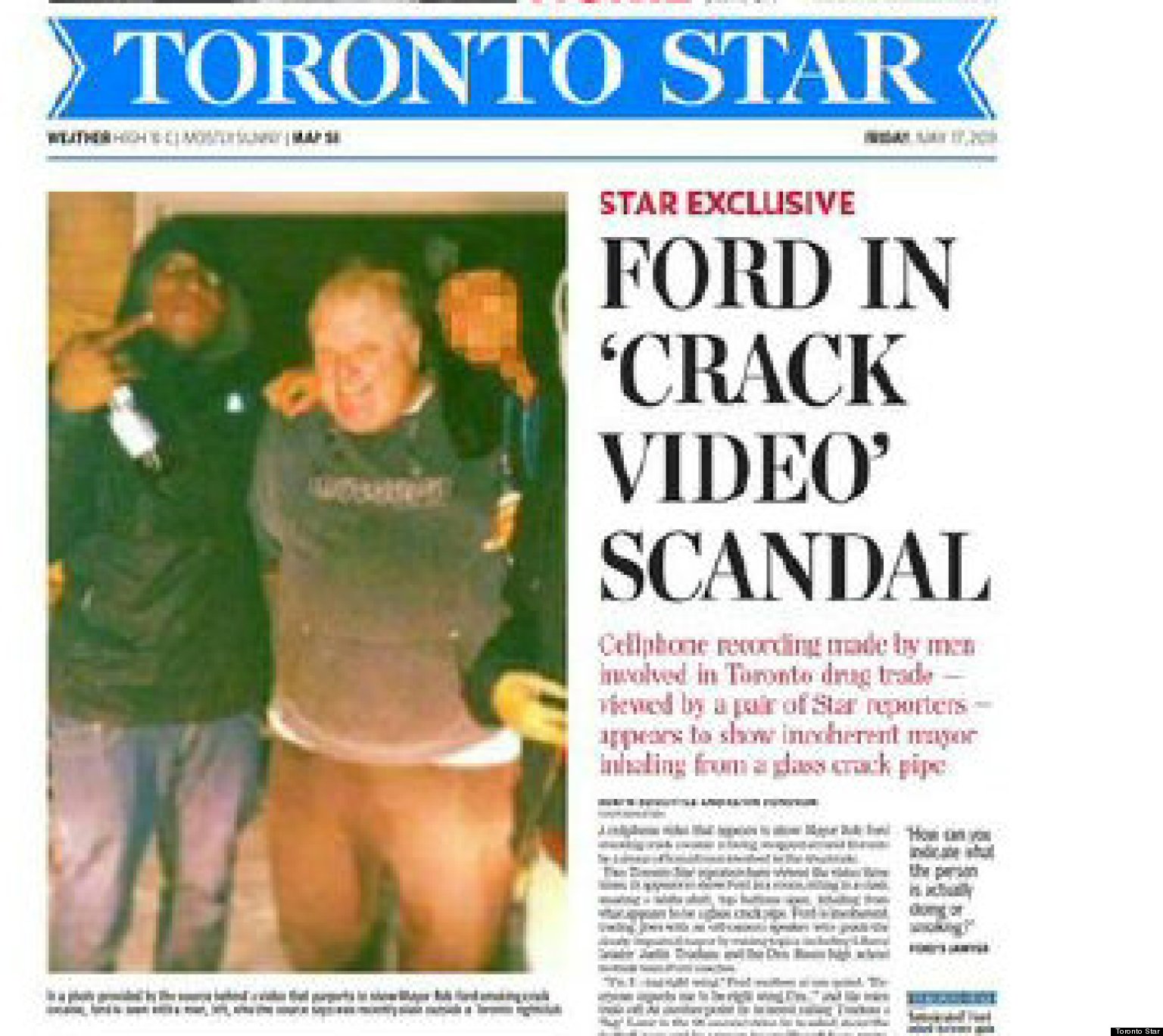
Tabloid trash-talking website Gawker.com claimed they saw a video of Toronto Mayor Rob Ford smoking a crack pipe, and the mainstream anti-Ford newspaper The Toronto Star ran with the story a week ago today.

The problem with using drug dealers as sources, is sometimes they make sh*t up.

Okay, that's a bit extreme. Even drug dealers are honest, hard working contributing members of society, right?

Yeah, right.

So it should be no surprise that the scoundrels at Gawker.com haven't been able to reach the drug lords that showed them the blurry, poorly shot iPhone video -- but wouldn't let them make a copy, or verify it's source.

The Toronto Star has been unable to reach the video's owners to verify its authenticity as well.

All of this hits as all things come to their inevitable end. Today, Toronto City Council's executive committee is sending a letter to their boss -- Mayor Rob Ford -- asking him to address the issue publicly. There are also rumours that the city's executive committee is asking for the Mayor to step down, and let the deputy mayor and the executive committee run the city until all the pressure from the media blows over.

And, Gawker.com itself is about set to reach it's drug-money-funding goal on crowdfunding website Indiegogo, to pay off the owners of the video behind this enormous scandal to rock Toronto, Canada.

Oh wait -- exactly who are they paying off again? Their "sources" have fled, just as they are about to make it rich.

Maybe money can't really buy happiness after all?

Or maybe the video was faked, by a couple of slimy druggies that thought they could bribe some gullible wanna-be American journalists with a poorly shot mobile phone video about some politician in another country.

Seems odd that legitimate sources would suddenly disappear, regardless of their chosen occupation. Especially sources about to hit the money load -- literally -- and be paid for their info.

Maybe they had a change of heart, and decided to come clean, and instead of using any profits from the video to further their drug trade, they'd donate it to a worthy cause, like the Centre for Addictions and Mental Health?

What are you, high?

The real damage ultimately is to the citizens of Canada, the residents of Toronto, and the business of running Canada's largest city.

Once again, Toronto Mayor Rob Ford's lack of tact has put more than his left-foot in his mouth, and caused all the above to be made the fool on the world stage.

All because some slimy druggies that wanted to make more money.

And because technology allows anyone these days to claim to be a journalist -- even if they don't have what it takes to really do the job.

Like common sense for one.

Dealing with drug dealers as sources that ask for money up front?

Come on now Gawker.com -- is that how the game is played in your f*cked up world?

Thursday, 23 May 2013

Why Toronto Mayor Rob Ford Needs to Resign

Unless you've been living under a rock on a secluded island in the middle of nowhere, chances are you've heard about some crazy Canadian big city mayor caught on video smoking crack cocaine.

Late night comedians Jimmy Kimmel and John Stewart both poked fun at recently on their late night talk shows. 

Major global news outlets, including CNN and the BBC have covered the story internationally.

Yet the only one speaking publicly about this is the media -- Toronto Mayor Rob Ford, as of this writing, STILL has intentionally evaded the press, simply saying quickly when the story first broke that allegations of him smoking crack cocaine are "ridiculous" and simply untrue.

So, what is the story?

For those hiding under rocks on secluded islands, an American tabloid website called Gawker claimed to have been shown a video showing Toronto Mayor Rob Ford smoking crack cocaine. Later that day, one of Canada's largest newspapers, The Toronto Star, claimed that two of it's reporters had also seen the video footage, and ran with the story.
Neither Gawker nor The Toronto Star have validated the video, because the shady characters that have the video want a million dollars for it's release.

Since The Toronto Star -- a newspaper that has had a long standing war with Rob Ford before he became mayor of Canada's largest city -- broke the story, the media has been on a feeding frenzy, trying to get the mayor to address the issue.
Gawker did what many tabloid organizations do -- try to build buzz using social media's crowdfunding. They created an Indiegogo campaign, to raise funds through donations to secure the video footage, from what the accused brother, fellow Toronto city councillor Doug Ford, calls "drug dealers."

Regardless of whether the video is legit, or simply a sham falsified by people that just want to make a dishonest buck, Toronto Mayor Rob Ford needs to step aside by resigning his post as Mayor for the good of the city and the country.

Toronto Mayor Rob Ford has been embroiled in many wild and weird issues since taking over as Mayor of Canada's largest city.

From failing to acknowledge gay rights by being the first Toronto politician to not attend the annual city's annual Pride Parade (all local politicians usually attend the annual event), to almost making history by becoming the first Canadian mayor to be forced out of the job by court order over a conflict of interest charge (which he won, so he didn't lose his job).

Sometimes, sadly, Mayor Rob Ford attempts to do the right thing, but it ends up exploding in his face. Like the time he and his brother Doug held a weight loss challenge for themselves, to get Torontonians interested in fitness and health. Every week both would publicly weigh themselves, showing how much they had lost. As the pounds crept back on, they quickly and quietly stopped showing up for the weekly weigh-ins and the media had another field day trashing the mayor and his family, despite their good intentions.

The latest scandal to rock the municipal offices of the third largest city in North America, and the largest city in Canada, has disemboweled the office of Toronto's Mayor, Toronto City Council, the city, and even the country.

When you have late night talk show hosts poking fun at the mayor of Canada's largest city, it makes all Canadians look bad.
And it isn't just American talk shows which are shaping the minds of potential tourists to our great country -- the sordid story of Rob Ford and his legacy thus far have been trending on social networks worldwide, and told on legitimate news outfits from the BBC to NPR and beyond.

That's why, regardless of whether the allegations of alleged drug use are true or false, Rob Ford and his brother do the right thing, and resign for the good of the city and the country.

It's time to clean house, and have a new mayor in power in Toronto. Because the world has lost faith in Toronto, and to a degree in Canadian politics, and the only thing that will restore that faith is a change of the guard.

Tuesday, 5 March 2013

Why Won’t Print Just Die


The death bell has been ringing for years in the newspaper business, as digital on-demand media becomes the way most of the western world keeps connected.

SO how come print just won’t die?

Funny thing about technology – it makes it possible for even old things to be new once again.

Maybe we’re just waiting for the right genius kid to discover a new technological solution to re-ignite the newspaper business?

That kid better hurry up – there’s not much left at most newspaper offices these days except a few old curmudgeons and the blurry eyed interns that don’t see the proverbial forest for the trees.

When I was a kid, we got The Toronto Star delivered to our home every day. When it came, we’d take turns ripping through it, looking for our favourite sections.
We always fought over the "Star Week" the paper's TV Guide, this was back long before on-screen program guides which we all have now.

I really enjoyed the national, local and international news sections, along with “Wheels,” and I even liked some of what us old school reporters used to call “the woman’s section” known as “Life.”

I remembered enjoying the full-colour comics on Saturdays, and how they packed extra stuff into the weekend papers.

Thinking back, I feel sorry for the kid that was our newspaper carrier at the time, because the Saturday Star must have weighed as much as a Smartcar.
Those were the days before the Internet, social media, and on-demand digital media. People had more time – or so it seems now – to read through all the various sections, gloriously getting inked fingers from the constant page-turning.

Not so anymore – all broadsheet-width newspapers reduced their standard width years ago, simply because it was becoming too expensive to make such Bible-sized publications.

When that happened over 20-years ago, it was the start of the end for print. Newspapers, like most media sources, make their money by advertisers. The more advertisers, the more pages a paper can be, the more stories can be jammed in.

As people stopped reading papers, advertisers pulled out, meaning fewer pages for the already popular sections.

So newspaper moguls cut the size of the physical paper. They claimed at the time it was to make it easier for people to read, and in a way it was.

But truth be told, it was because newsprint costs went up, while ad revenues and readership went down.

Many major metropolitan daily newspapers including The New York Times, The Globe and Mail and others have attempted “pay walls” to bring in much needed cash flow.
A “pay wall” essentially lets you read part of a story, or a certain number of articles from the publication online, and then after that limit, you have to either pay for an online subscription, or pay a set price per article to continue reading.

Though when it comes to the end product – news – who’s going to pay for something you can get for free in a more timely manner via television, radio, or the social networks?

Pay walls aren’t going to save newspapers from their death.

And yesterday’s announcement of staff cuts and outsourcing labour by Canada’s largest daily certainly puts another knife in the back of an already dying media business.

Although I’m a digital media guy, I’ve always enjoyed newspapers, and hope that someone, somehow figures out a way to save them.

But time is not on their side, as they continue to slash staff, outsource production, and lose money, in our on-demand digital media world.

Thursday, 17 May 2012

Canada’s Largest City Mayor – In More Ways than You Think

Ah Rob Ford, you really do what you say – which is a wonderful rarity from politicians these days. 

For those outside the Greater Toronto Area, Rob Ford is Toronto’s mayor. And he really acts on what he says.

But from his actions, sometimes I wonder if he doesn’t always think first, before speaking or acting?

A once-great Canadian newspaper – The Toronto Star – has picked a battle with Ford, stalking him to the extent that the mayor has not only refused to talk to that paper’s reporters, but said recently that if any Toronto Star reporters are present during a press event, he’ll stop talking at that press event.

The Toronto Star used to be one of Canada’s great papers, until they started acting more like a British rag – maybe that’s due in part to some new editors over at their offices with British Tabloid blood in their veins?

The Toronto Star recently sent a young reporter to spy around Toronto Mayor Rob Ford’s home, at night, in the dark, with just the camera on his phone. The mayor wasn’t called ahead of time, asked or even told that this would be done.

As the story goes, when Rob Ford heard someone was prowling around his family homestead, he went on the rampage, chasing after this young reporter.

Naturally, the headlines the next day were all about Mayor Ford, chasing a reporter off his property.
What the Toronto Star did was wrong and the mayor was the victim of a horrible form of harassment, unbefitting a so-called “professional” news publication.

However, what the mayor did was also wrong.

By chasing after the reporter, Mayor Rob Ford continued to feed the tabloid junk the Toronto Star – and the rest of the media that day – was to report on.

By acting without thinking, the mayor created a story which put him in the negative, despite the fact that he could have turned it around and made it quite positive.

Had the mayor slowly approached the sneaky reporter, offered him a chance to come into his home and talk as two reasonable adults, then the headlines wouldn’t scream in the morning about him chasing another person.

Mayor Rob Ford feeds the media by failing to act in his best interests all the time. Toronto’s mayor and his brother Doug Ford, aren’t slim. During the election campaign which got them elected, a person claiming to be a doctor stood up during one of the televised debates, and said to Rob Ford that he looked like a heart attack waiting to happen.
Tyler Anderson/National Post 
Mayor Rob Ford and his political partner now a fellow councilor Doug Ford, announced in the spring the “Cut the Waist Challenge” where the two of them would go on a diet to lose weight. Mayor Ford’s goal is to lose 50 pounds by June – next month.

Public Relations Fiasco or Good Politics?

From a public relations perspective this is a great thing – it shows a human side to Toronto’s mayor, and encourages people of all sizes to be healthy.

And when the first of the weekly weigh-ins started, the mayor and his brother had dropped a few pounds – way to go!

But lately, the mayor’s been gaining weight – he was up four pounds at his last weigh-in -- he’s cancelled previous weigh-ins, and recently announced the once weekly media events would take place every other week.

He’s avoiding the media, which again feeds the gossip and rumor machine, instead of managing it.
Health experts tell us it’s normal for people on diets to yo-yo up and down in weight. What the mayor and his brother should do, is admit their struggles during these weigh-ins, instead of running and hiding. 

Canada’s largest city has had a number of interesting characters run it. Mel Lastman was a great mayor, which was also outspoken and drew the attention of the media wherever he went.
 
Lastman occasionally got into hot water by acting without thinking too. But Lastman had a great media machine around him, and he eventually learned how to use the media to get what he wanted.

I remember, many eons ago, when I was a reporter covering city hall, and then-mayor of Toronto, Mel Lastman actually broke down and cried when a subway expansion he had promised during his last election campaign was defeated.

After pictures of the mayor sobbing, head down on his desk hit the streets in newspapers and on TV, an emergency session of council was announced and then after the meeting the subway expansion was back on the table, and construction would begin in the fall.

The councillors looked bad, by making the mayor cry. Whether or not those tears were real or forced for the cameras we’ll never know. But the then-mayor’s tears worked, and that subway is up and running today.

Toronto Mayor Rob Ford should take a page out of Mel Lastman’s playbook, and learn how to use the media, rather than feed the media.

‘Cause anyone that feeds the media is made to look the fool – because they aren’t thinking before they speak.

Tuesday, 15 May 2012

An Example of Social Media Gone Wrong – Print Media’s Suicide

Last week, one of Canada’s large national newspapers announced that it will start charging readers for it’s online editions.
 
The Globe and Mail said it will allow readers to view a as-yet-undetermined amount of stories online, and then afterwards force them to subscribe to the paper to continue reading.

They are taking a page from the American New York Times, which has been charging online readers for their stories.

Wait a sec . . . wasn’t print declared dead long ago?

A recent study on the best and worst 200 jobs to have cited ‘newspaper reporter’ as one of the top 10 worst jobs to have, because of declining readers, and consequently a lack of jobs. The article mentions how most people get their news from the Internet and then television or radio, often not having time to read a full newspaper.

Many newspapers across the globe have simply closed their doors, sending their reporters scattering looking for work, because of this decline in readership, due in large part to other free sources of instant news online.

So what were the editors at The Globe and Mail thinking when they thought they could build a revenue stream off the backs of their already declining readership?

Look to the other end of the digital spectrum to see The Huffington Post, the world’s largest and most respected completely online – and FREE – newspaper. This online source for news and information has quickly become an enormous success for founding publisher Arianna Huffington. Yet she’s giving away her product free.

Will Canada’s Globe and Mail, one of the oldest papers in Canada, which was the last true broadsheet paper until newsprint costs cut column inches, survive by charging for what others give away for nilche?

Granted, newspapers, magazines and other subscription-based services will always have their dedicated customer niches, which, if they have the money to burn, will.

However, as the global economy continues to fail, jobs continue to decrease, and the cost of living continues to rise, the disposable income those niche customers have to burn disappears.

Meaning no matter how much someone enjoys reading a particular column, section or day in a pay-based publication, if the same sort of content is available elsewhere for free, the free publication will always win.

When I was a print reporter years ago, Canada only had one national paper, which was The Globe and Mail. I’d read it, along with the other main dailies, watch the three major network’s national newscasts, and listen to the local radio station’s news on the hour.

Times have really changed.

There are two national papers in Canada – three if you consider the Toronto Star national because of its size and distribution. The big three Canadian networks now drown in a sea of digital cable and satellite channels available from around the world, including the now popular 24-hour news network channels.

And the Internet also didn’t exist during the era when newspapers were king.

Paying for subscriptions to the digital editions of a dying media sounds like a nail in the coffin for that dying media.

Surprisingly, that nail is being hammered in directly by those who manage that dying media – which makes me wonder – is the death of the print newspaper suicide?