Showing posts with label Social Media. Show all posts

Thursday, 23 May 2013

Why Toronto Mayor Rob Ford Needs to Resign

Unless you've been living under a rock on a secluded island in the middle of nowhere, chances are you've heard about some crazy Canadian big city mayor caught on video smoking crack cocaine.

Late night comedians Jimmy Kimmel and John Stewart both poked fun at recently on their late night talk shows. 

Major global news outlets, including CNN and the BBC have covered the story internationally.

Yet the only one speaking publicly about this is the media -- Toronto Mayor Rob Ford, as of this writing, STILL has intentionally evaded the press, simply saying quickly when the story first broke that allegations of him smoking crack cocaine are "ridiculous" and simply untrue.

So, what is the story?

For those hiding under rocks on secluded islands, an American tabloid website called Gawker claimed to have been shown a video showing Toronto Mayor Rob Ford smoking crack cocaine. Later that day, one of Canada's largest newspapers, The Toronto Star, claimed that two of it's reporters had also seen the video footage, and ran with the story.
Neither Gawker nor The Toronto Star have validated the video, because the shady characters that have the video want a million dollars for it's release.

Since The Toronto Star -- a newspaper that has had a long standing war with Rob Ford before he became mayor of Canada's largest city -- broke the story, the media has been on a feeding frenzy, trying to get the mayor to address the issue.
Gawker did what many tabloid organizations do -- try to build buzz using social media's crowdfunding. They created an Indiegogo campaign, to raise funds through donations to secure the video footage, from what the accused brother, fellow Toronto city councillor Doug Ford, calls "drug dealers."

Regardless of whether the video is legit, or simply a sham falsified by people that just want to make a dishonest buck, Toronto Mayor Rob Ford needs to step aside by resigning his post as Mayor for the good of the city and the country.

Toronto Mayor Rob Ford has been embroiled in many wild and weird issues since taking over as Mayor of Canada's largest city.

From failing to acknowledge gay rights by being the first Toronto politician to not attend the annual city's annual Pride Parade (all local politicians usually attend the annual event), to almost making history by becoming the first Canadian mayor to be forced out of the job by court order over a conflict of interest charge (which he won, so he didn't lose his job).

Sometimes, sadly, Mayor Rob Ford attempts to do the right thing, but it ends up exploding in his face. Like the time he and his brother Doug held a weight loss challenge for themselves, to get Torontonians interested in fitness and health. Every week both would publicly weigh themselves, showing how much they had lost. As the pounds crept back on, they quickly and quietly stopped showing up for the weekly weigh-ins and the media had another field day trashing the mayor and his family, despite their good intentions.
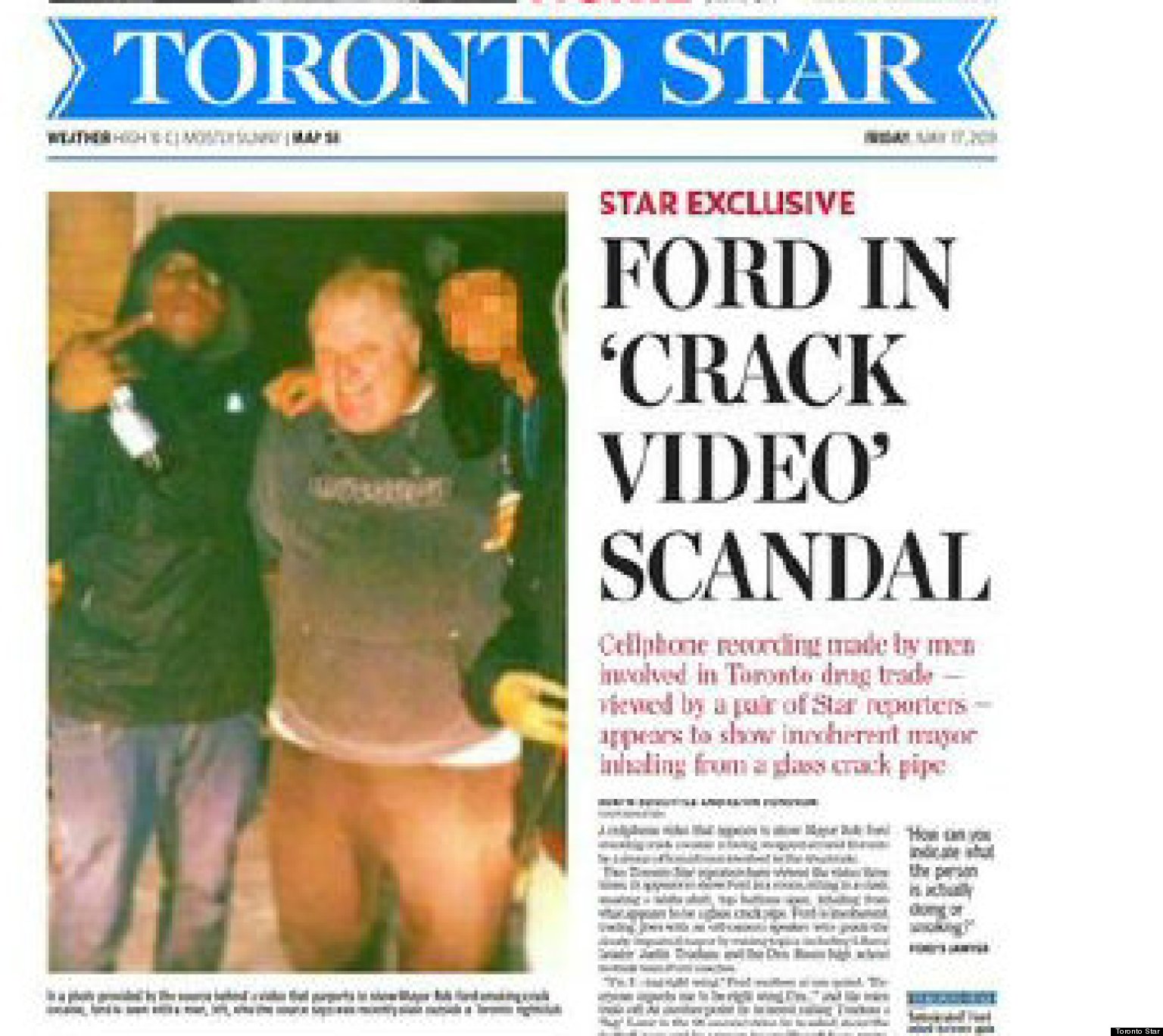
The latest scandal to rock the municipal offices of the third largest city in North America, and the largest city in Canada, has disemboweled the office of Toronto's Mayor, Toronto City Council, the city, and even the country.

When you have late night talk show hosts poking fun at the mayor of Canada's largest city, it makes all Canadians look bad.
And it isn't just American talk shows which are shaping the minds of potential tourists to our great country -- the sordid story of Rob Ford and his legacy thus far have been trending on social networks worldwide, and told on legitimate news outfits from the BBC to NPR and beyond.

That's why, regardless of whether the allegations of alleged drug use are true or false, Rob Ford and his brother do the right thing, and resign for the good of the city and the country.

It's time to clean house, and have a new mayor in power in Toronto. Because the world has lost faith in Toronto, and to a degree in Canadian politics, and the only thing that will restore that faith is a change of the guard.

Monday, 22 April 2013

So What Is On-Demand Internet Television?

Millions have already cut the cord with their cable or satellite providers, and are enjoying television anytime, and on any device they have via on-demand services over the Internet.

Problem with many of these on-demand services, is they serve up the same distasteful menu of Reality TV, sitcoms, game shows, and even re-runs of once great shows, but nothing new, and original.

And when they do their own programming, just because it receives rave reviews from the television critics, doesn’t mean you are going to like it.

Television is like food – we all have different tastes.

Some like it spicy, others run to the bathroom at the mere thought.
The same goes for television shows. Actually, it’s even more so for television – we all have such varied and unique interests, hobbies, career aspirations – so naturally we’ll all have very different tastes in what we like to watch on television.

That’s the magic of our crowdfundng project – we open up the discuss forums, giving you a voice.

Be heard – tell us what YOU want to see on television.

If enough people get talking about it, we’ll create the show – and FINALLY there will be something YOU want to watch on television.

Even better, because it’s on-demand over the Internet, YOU can watch it when you want too, and on any connected device.

So while waiting in line at the grocery story, you can be watching your favorite show on your mobile phone, and thanks to cloud-based computing, you can continue watching your favorite show after you put your groceries away on your connected big screen television in your living room!

All of this can only happen with YOU.

So please help us make on-demand Internet television possible. DONATE to our crowdfunding project NOW – we’ve got some great gifts as our way of saying ‘thank you.’

Once you’ve made your contribution, don’t forget to spread the word – the more people that know we exist, the better. Tell EVERYONE you know via Twitter, Facebook, Google+, Pinterest – whatever social network you are on – please share this link. 

Thank you for making On-Demand Internet Television matter.

Saturday, 20 April 2013

End Boredom, Get a Perk, Feel Good -- Why Not?

Yesterday I launched my very first crowdfunding project on Indiegogo -- On-Demand Internet Television.


Crowdfunding is using social media to  raise funds for anything – be it a business, a creative project, or as in my case – a bit of both. From a business start-up point of view, it’s also a great way to see if the business idea has a market, because you can see by how many fans do – or don’t – jump on board to support it either through promoting it via their social networks, contributing ideas to help it grow, or even donating to the cause to ensure it takes shape.

You may have heard of websites like Kickstarter and Indiegogo – these are the biggest and most talked about crowdfunding websites out there, which help people raise funds by growing a social following of people interested in seeing their ideas happen.

Of course, there’s also something in it for the fans that donate to the cause – gifts are set at different levels of funding which encourage people interested in making the idea happen, to open up their wallets.

The On-Demand Internet Television crowdfunding project is a really cool one -- which I hope you will check out, select a perk, and even share it with your social circles to make it happen.

Help us rid the world of boredom, by creating the first television network with programming that you'll actually watch.

How do we know you'll watch it?

Check out the crowdfunding site here to learn more, and please help us make this possible by donating to the cause and sharing the site with your friends.

Over the next 50 days, I'll be using this blog to share my thoughts, feelings, successes and failures about crowdfunding the worlds first viewer created television network.

See what challenges we go through as we crowdfund -- great if you have an idea you've always wanted to try, but just don't know how to raise money to start it.

Thanks for reading this blog -- and for supporting our crowdfunding project!


Monday, 8 April 2013

The Iron Lady is No More


Former British Prime Minister Margaret Thatcher passed away from a stroke – she was 87.

I remember the Iron Lady – given that nickname by the tabloid British press for her unwavering stance on her economic policies which at the time caused protests in the United Kingdom, but were hailed as revolutionary and necessary changes by the leaders of Canada, the States and even the former Soviet Union.

Ah, the former USSR – or Soviet Union. When Baroness Thatcher was Prime Minister, the world was a very different place.

Thatcher’s Conservative Prime Minister reign ran from 1979 to 1990, right through the Cold War, and long before cell phones, smartphones, tablets and most of the mobile devices we take for granted today existed.

The Cold War was a frightful period for the world. It was a time when the world’s superpowers – The United States of America and the Soviet Union – were constantly at loggerheads over the way the world should be run, and at anytime, the world was ready to take cover from a nuclear strike by either superpower.

Or as ready as you could realistically be for the end of the world.

Fear over a nuclear holocaust was real. If you look back at the movies of the time, many were either about such a holocaust, or the fear of coming to the brink of such a holocaust, as the trigger-happy American’s edged closer to “DEFCON 1” – the codename used to signal the start of a nuclear war.

There was a now legendary tale about how a flock of Canadian Geese raised the DEFCON threat levels, when they showed up on NORAD’s radar, but failed to identify themselves, despite the NORAD commander’s urgent calls on the radio.

Luckily, a couple of F-16 fighter pilots were dispatched, and once they saw it was a flock of birds and not missiles or enemy fighter planes, everyone breathed a sigh of relief, maybe even had a bit of a chuckle.

Yes, Margaret Thatcher’s Iron Lady stance governed through some very interesting times. She worked on the world stage with other charismatic characters, trying to balance the power while maintaining the peace in very uncertain times.

If a flock of Canadian Geese could set off alarm bells, it’s any wonder how we somehow managed to avoid a nuclear war.

Or is it?

Before the world of instant always on and always available communications, the true test of political leadership was character.

Back in Margaret Thatcher’s time, email, cell phones, smartphones and other mobile devices just didn’t exist. So what really made a leader a great leader, was compassion, empathy, honesty, and above all else, being charismatic and an exceptional communicator.

Margaret Thatcher certainly was on par with the other great leaders of the time – American President Ronald Reagan (who’s nickname was “the great communicator,”) and the deep voiced and chiselled chin Canadian Prime Minister Brian Mulroney, who’s sense of humor often stole the show at press events where all three were in attendance.

The ever prim and proper Margaret Thatcher was like the stern but loving mother, keeping President Reagan and Prime Minister Mulroney on track and out of trouble.

The Cold War has long since ended, and the type of leadership our world needs has since changed forever.

However, the compassion, empathy, honesty and charismatic communications of the Iron Lady will be missed, in our new world of social media, and always on digital communications.

Thursday, 28 March 2013

What “Friend” Means in the Era of Social Media


Stolen right from the pages of Star Trek lore, physicists in Texas are working on a way to make physical objects invisible by bending light waves.

Despite the similarity to the Romulan Bird of Prey cloaking technology from the 1960’s television show Star Trek, which hid these enemy ships from the Enterprise crew during battle, we’ve all had access to our own personal cloaking device.

Many instant messaging programs allow you to be cloaked, so you can see your friends online, but they can’t see you.

In Microsoft’s Skype, you can change your status to “Invisible” which allows you to see any of your contacts online, while maintaining your appearance as “Offline” – in effect, hidden from view, or cloaked.

This begs the question – why would you hide from your friends?

Perhaps the word “friend” has changed thanks to Facebook, Twitter, Google Plus, and all the other social media sites.

It isn’t uncommon to have a few hundred, or even a few thousand “friends” following your every post, tweet and hangout.

Used to be, you’d only really call someone a “friend” if you actually liked spending time with someone in the here and now, in the real world.

These days, people “friend” each other on Facebook, and the other social networking sites without really ever knowing who they are in the real world.

Many add complete strangers as friends, and then in turn, you feel compelled – almost guilt-ed – into adding them back – even though you haven’t a clue who they are.

For all you know, you may have added the next Charles Manson, or some other mass murderer as one of your online “friends.”

But don’t worry, the police probably won’t come knocking on your door.

The word “friend” really has changed thanks to Mark Zuckerberg’s Facebook.

What was once used to reference people we actually knew, liked and in many cases loved, is now a loose and ambiguous term for the strangers we occasionally share random thoughts with.

We all have real friends – or at least I hope you do – that you can really depend on in a pinch.
They listen to us vent, share in our joy, and are there when we need a shoulder and a hug.

And some have been lucky to really connect with those online, and may even have some friends from their social networks they can vent, share and hug too.

However, for the most part, having a zillion “friends” online doesn’t mean you have a zillion people you can depend on.

But I suppose it’s nice to believe that.

Thursday, 21 March 2013

Wearable Tech and Its Impact on the Modern You


As wearable technologies like Google Glass and the rumoured Apple iWatch are making headlines – and neither product has been released to consumers yet – it raises the real question, just how life changing will all this tech you wear be?

Very life changing.

Immensely life changing.

Imagine the cute salesperson trying to sell you a new whatchamacallit starts flirting with you big time. You’re instantly attracted to the bright eyes bashing about you – but you don’t know anything about this person.

Using your Google Glasses, you conduct a Google search of the person’s face, and instantly find from their Facebook profile that they went to the same university, studied Environmental Studies, have a dog, and appear to post a lot about hating their work – which is where you are now.

Hmmm.

You bring up their LinkedIN profile and see they used to be a manager of a bank, and have worked on and off in retail and telemarketing.

Hmmm.

You check out their Twitter page and see they recently had a sex change.

Moving on.

Despite the fictional scenario, all of those things – and more – could be quite possible if the smart folks at Google use technologies already widely available – facial recognition, voice commands, and the ability to access search results from those voice commands.

Aside from a lot of lonely nights for our fictitious sales person, what if the reverse happened to you, but instead of a potential date, you were being interviewed for a job?

We’ve all been warned not to post anything online that a potential employer might take offence too – but who listens to free advice these days?

As you sit there, describing yourself and where you want to be in five years, that potential employer could be seeing your drunken pictures posted on Google Plus, or that video you posted of your old boss picking her nose on YouTube.

Don’t worry, there are lots of other great places to work.

Even the rumoured iWatch – and we all know most products Apple leaks out as rumours actually are released – could be a source of pain for those in the hot seat.

It’s bad enough when friends go out to spend a great time with each other, only to ignore each other most of the night as they gaze eyes-down into their mobile devices.

Only with the iWatch, those eyes will be on each other’s own wrists, texting, tweeting, posting updates, checking the scores of your favourite sports teams.

Kind of defeats the whole point of hanging with friends.

Though I suppose there is one benefit to all this wearable tech – unlike our phones which we put in our pockets, rarely do we take off our watches and glasses, so the excuse: “I accidentally tossed my tech in with my clothes wash,” just won’t hold.

But people lose watches all the time.

Hmmm. 

Wednesday, 20 March 2013

Canada's Budget Locked Down But Tweeted

It's almost budget day in Canada.

I know.

So what?

Unless your an economist, politician, news junkie, or have nothing else to do, the fact that Canada's Finance Minister put on his new shoes, and is ready to deliver his new budget tomorrow for the nation just doesn't matter much.

That's why the feds in Ottawa are hitting social media mega-site Twitter, to spur up some social media interest, and engage Canadians in one of the most important, yet yawn-inspiring political functions of the nation's governance.

Traditionally, journalists are locked down prior to the delivery of a budget. They are herded like cattle into a room, where they get exclusive access to the actual budget.

This allows newshounds reporting on the budget to understand and comprehend the massive financial blueprint of a nation.

However, journalists aren't allowed to discuss what they see until after it's been announced. 

That's the law. 

It'll be interesting to see if politico-junkies manage to keep their excitement muted long enough to obey the law, or if the instant communications of social media leaks budget news ahead of the finance Minister's announcement.

Using social media in politics isn't all that new -- more "newish."

American President Barack Obama successfully used social media to get elected in his past and recent election bids for the presidency. He and his staff continue to use social media to engage younger people in the management of their country.

And perhaps that's the greatest good today, when Canada's Finance Department will tweet news about the new budget.

Budgets are typically long, dull and dreary financial statements. Not usually the stuff which attracts young people to politics.

However, budgets form the foundation from which all other government programs come. From tax breaks for students, to how much the government will fund student loans and repayment programs, to providing tax credits for low income families to send their kids to school -- budgets affect young and old people across Canada.

Using Twitter -- and maybe down the road other social media sites like Facebook, Google Plus, maybe even YouTube and Pinterest -- is a step in the right direction for Canada's Finance Department, and one all federal, provincial and municipal departments should take note of and follow.

Because a more politically aware and engaged youth means a more politically aware and engaged future.

And that's just good governance.

Saturday, 9 March 2013

Toronto Wanna-Be Mayor Cries Wolf


Last week, International Women’s Day was tarnished by the brash sexually abuse accusations fired at a big city mayor by a woman he defeated in the last election campaign.

Thomson, who ran against Toronto’s Mayor and lost, didn’t follow the usual course of action by a victim of sexual assault and report it to police. Instead, she blasted Mayor Rob Ford publicly on social media, posting a picture of her smiling, alongside the accused on Facebook.

Mayor Ford denied Thomson’s whole story, claiming none of this happened, and that she was crying wolf.

Numerous people at the event, even those not traditionally supporting the controversial Toronto mayor have spoke out against Thomson, claiming they clearly saw that none of what she was claiming happened.

A handful of local politicians are even coming forward, saying they overheard Thomson talking about intentionally setting up Mayor Rob Ford, to further her own political aspirations.

Thomson claims if anything, publicly talking about this would hurt her political career, as she’ll be known as the “ass grab” politician.

Sarah Thomson – formerly Sarah Whatmough – unsuccessfully ran for a municipal council seat in her native city of Hamilton, Ontario, Canada in 1997. She then launched a monthly newspaper called the Hamilton Examiner in 1998, which shortly ceased publication. Since then, she moved to Toronto, ran unsuccessfully against Rob Ford, and failed again in politics, when she ran locally for the Provincial Liberal Party in 2011.

Her bold and potentially criminal charges – despite her lack of filing a police report – was the first time in a long time the 45-year-old Thomson had been in the public eye, with just about every news organization in the city clamouring for an interview.

Allegations of sexual abuse are traditionally he said, she said debates, hammered out in a court of law. And make no mistake, sexual assault is one of the most distasteful and disruptive of crimes one person can commit against another. 

Victims of sex abuse often endure years of therapy, as they overcome the horrible events of their past. Some never fully recover.

However, Thomson is acting more like a person with a mission, than victim, as of this writing, she still hasn’t filed a police report, laid criminal charges, or sought any of the traditional sources for assistance and recovery from sexual abuse which one would normally take in such matters.

All Sarah Thomson has done, is as Toronto Mayor Rob Ford has said, is cry wolf.

If what Thomson is claiming is true, than the mayor of Canada’s largest city should be held fully accountable for his actions.

If on the other hand, Thomson is just crying wolf to rally for her personal gain, not only should she be held fully accountable for her actions – which she will because no one will believe or trust her ever again – but she should also meet with and learn from actual victims of sexual abuse.

Because those who’ve been harmed sexually often have the longest road of recovery. And perhaps, if she learns from those who’ve got more than a Facebook page with unsupported allegations to cry wolf from, she’ll realize just how devastating sexual assault is on those who’ve actually been assaulted in this manner.

And that will make her – slightly – a better person, even if she just cried wolf.

Tuesday, 5 March 2013

Why Won’t Print Just Die


The death bell has been ringing for years in the newspaper business, as digital on-demand media becomes the way most of the western world keeps connected.

SO how come print just won’t die?

Funny thing about technology – it makes it possible for even old things to be new once again.

Maybe we’re just waiting for the right genius kid to discover a new technological solution to re-ignite the newspaper business?

That kid better hurry up – there’s not much left at most newspaper offices these days except a few old curmudgeons and the blurry eyed interns that don’t see the proverbial forest for the trees.

When I was a kid, we got The Toronto Star delivered to our home every day. When it came, we’d take turns ripping through it, looking for our favourite sections.
We always fought over the "Star Week" the paper's TV Guide, this was back long before on-screen program guides which we all have now.

I really enjoyed the national, local and international news sections, along with “Wheels,” and I even liked some of what us old school reporters used to call “the woman’s section” known as “Life.”

I remembered enjoying the full-colour comics on Saturdays, and how they packed extra stuff into the weekend papers.

Thinking back, I feel sorry for the kid that was our newspaper carrier at the time, because the Saturday Star must have weighed as much as a Smartcar.
Those were the days before the Internet, social media, and on-demand digital media. People had more time – or so it seems now – to read through all the various sections, gloriously getting inked fingers from the constant page-turning.

Not so anymore – all broadsheet-width newspapers reduced their standard width years ago, simply because it was becoming too expensive to make such Bible-sized publications.

When that happened over 20-years ago, it was the start of the end for print. Newspapers, like most media sources, make their money by advertisers. The more advertisers, the more pages a paper can be, the more stories can be jammed in.

As people stopped reading papers, advertisers pulled out, meaning fewer pages for the already popular sections.

So newspaper moguls cut the size of the physical paper. They claimed at the time it was to make it easier for people to read, and in a way it was.

But truth be told, it was because newsprint costs went up, while ad revenues and readership went down.

Many major metropolitan daily newspapers including The New York Times, The Globe and Mail and others have attempted “pay walls” to bring in much needed cash flow.
A “pay wall” essentially lets you read part of a story, or a certain number of articles from the publication online, and then after that limit, you have to either pay for an online subscription, or pay a set price per article to continue reading.

Though when it comes to the end product – news – who’s going to pay for something you can get for free in a more timely manner via television, radio, or the social networks?

Pay walls aren’t going to save newspapers from their death.

And yesterday’s announcement of staff cuts and outsourcing labour by Canada’s largest daily certainly puts another knife in the back of an already dying media business.

Although I’m a digital media guy, I’ve always enjoyed newspapers, and hope that someone, somehow figures out a way to save them.

But time is not on their side, as they continue to slash staff, outsource production, and lose money, in our on-demand digital media world.

Monday, 11 February 2013

Pope’s Resignation Signals the Death of Faith


For the first time in over 600 years – and only the second time in history – the leader of the Catholic Church has let his instincts – and not God – determine his faith.

Today, the world’s media is buzzing with news that the 85-year-old Pope Benedict XVI will resign on Feb. 28.

Sighting “advanced age” as just cause to break with traditions, the Pope announced his retirement while most of the western world was asleep.

Organized religion – particularly the Catholic Church – has taken quite a beating over the years. 

As science and technology continues to advance, and we see the world for the way it really is – and not necessarily how our ancestors once thought it was – we are a world which is losing faith.

With the scandalous $2.2 billion the Catholic Church has had to pay to victims of sexual abuse by their clergy, it’s only continued the downward spiral of organized religion even further.

So news of the Pope’s resignation is another blow to the church, and to religion as a whole.

Most Papal leaders don’t chose their own fate – that’s God’s decision – so the only way they retire is literally by death.
Having a Pope decide his own fate, shows a lack in faith by the one person who’s job it is to instill it in others.
This resignation comes shortly after the Pope began his official Twitter account, and began spreading his religious tweets around the world in numerous languages.

Perhaps the Pope’s own experience with technology has shown him his true age, and in part formed his decision to quit his job so suddenly?

Scientific and technological advances have always clashed with the beliefs of organized religion, yet in the end, it’s the science which has proof to back it’s claims, while religion has always claimed it’s a matter of faith.
From Copernicus that found out the Sun was the centre of the galaxy, not the Earth, as the Catholic Church believed, to Galileo’s first glimpses into the heavens using his own home-made eye-piece – both were banished by the Catholic Church for their scientific discoveries which we know to be true today.

The constant tug-o-war between religious beliefs and scientifically provable theories continues to this day. The whole Right to Life movement sprung forth from religious beliefs about the when a fetus is considered a person, and there is still a controversial movement trying to encourage our public education system to teach we all came from Adam and Eve, not from a Darwin-based theory of evolution, as science as proven.

I remember growing up in the suburbs of Canada’s largest city – Toronto – and every morning, my school day started by reciting the Lord’s Prayer.

I went to a public school, and not being of the Catholic Faith, I never identified with that prayer. I just did it because everyone else did – and being a young kid, I didn’t know any better.

Looking back, I sometimes feel cheated by the very people that taught me to read and write, because they forced their religious beliefs upon me at a time when I was too young to even think of such things. Not that saying the Lord’s Prayer damaged me in some way, but too make it appear a normal part of everyday life for everyone, when it is not, was an abuse of power.
It was only a few years ago that the Lord’s Prayer was officially dropped from the public school system which I went through, as educators finally came to the realization that not everyone believes in the same religion, and maybe there was something unethical in their preaching’s.

Our society continues to evolve and grow as our world becomes smaller, through technology.
Perhaps the time has come for us all to question our faith – and resign our religious beliefs – just as the leader of the Catholic Church did today?

Thursday, 7 February 2013

Why Do You Tweet?


It took me a while to embrace social media. I was a late social networker.

I tried Myspace when it first started, got tired of Tom and moved on over to Facebook, discovered Twitter, YouTube, Google Plus, Instagram, Tumblr, Pinterest and now I’m addicted.
Social networking has become more than a hobby. It’s a daily ritual.

But why do I tweet?

Why do you friend, follow post and pin? Why do you take out your smartphone in a restaurant, and insist on taking pictures of your food in a restaurant, and uploading those images to Instagram before enjoying the taste?

Since social networking began, we’ve been told how it’s all about creating your own personal brand – essentially about making you look good, in a consistent and continuous way online.

You are your own product – just virtually represented.

But many old school social media junkies, or even just ‘newbies’ new to the online world of social networking, don’t have a personal brand, they just post what they are doing, what they are thinking, or what they are experiencing.

And isn’t that what social networking really was about?

Sharing your life experiences in an online virtual social realm, with others doing the same, so you could learn, develop and grow your friends?

Wasn’t the whole point of Facebook to reconnect with family, friends and colleagues that you originally lost touch with?

Twitter’s original homepage encouraged people to tweet “what you are doing right now.”
The essence behind YouTube was the ability to record video of what you were doing, and share it with the world.
Then the friending addiction kicked in, and many of us – myself included – became more interested in growing our friends, fans, and followers.

There may be strength in numbers, and it certainly is impressive to have a million friends following you on Google Plus.

But how many of those people do you actually have real conversations with, and really enjoy getting to know?

How many of those people do you actually care about?

The real test of friendship, is asking yourself if you care about someone.
Social networking has come a long way, but perhaps it has fallen off the rails, as we race to have more friends, fans, followers, circles, subscribers and others we really don’t care about.

Perhaps it’s time to rethink being social?

Why do you tweet?

Monday, 17 December 2012

Newtown Shooting the Media and You


Horror, shock, disgust, anger, rage, sympathy, sadness.

These are some of the many feelings we all went through, as news of the tragic shooting of innocent little kids in small town America spread.

The president of the United States cried as he responded live on television to the mass murder in Sandy Hook Elementary School, in Newtown CT.

Last night, parents, families, friends, and neighbours all gathered in a small school gymnasium, while local religious leaders offered words of hope and prayer during the public memorial service for the victims of another act of random violence in America.

American President Barack Obama gave a solemn message of hope, saying that we cannot go on allowing this sort of thing to happen. This isn't the first time the American president has addressed parents and families of a school shooting.

World leaders issued statements, expressing their horror over the incident, and offering their condolences for the families and friends of the victims.

Parents all over the world echoed thoughts of hugging their children extra tight that night on all the major social networks.

Today has been labelled “Hug Your Kid Today” to encourage parents to hug their children, and tell them they love them.
Maybe tomorrow will be “Bring an Apple, Not a Gun to School” day?

When I was a kid, the most violent thing anyone ever witnessed was the occasional fist fight between two jocks trying to woo the same cheerleader.

Back then, it was too much testosterone and the foolishness of a youthful mind which occasionally caused someone to get a black eye.

These days, social pressures on our youth – and us all – build up until we explode. Most just punch a pillow, write a nasty blog, or maybe snap at their spouse.

Then you get those with access to guns.

They shoot people.

Innocent people.

People going on about their daily lives, not aware that today is their last day on Earth.

Over the next few hours, days and weeks, as the victims are laid to rest, the media will focus on the never-ending question about gun control in the land of the free and the home of the brave.

The American Constitution’s Second Amendment tells citizens of that once great land, they are not only allowed to carry fire arms, but encourages them to use them to defend their freedom.
That fine piece of legalize – which is defined as the Supreme Law of the United States of America – was written in May of 1787, and adopted in September of that year by the Constitutional Convention. The law of the land was ratified by the then 11-member states, and went into effect on March 4, 1789.

Back in the 1700’s one could understand the logic of allowing people to own and use guns to defend their property. It was a very different time, long before the microchip.

The world was an unsettled place – a global wild west. The French Revolution began with the fall of Bastille on July 14, 1789. The Spanish captured the British schooner ‘Northwest America’ near Vancouver in June of that year.

It was the same year that Benjamin Franklin wrote: “there is nothing certain in life, except death and taxes.”
It was a time when governments were battling each other for land.

No wonder the founders of the United States of America wrote into law, the right to carry and use guns.

Times really have changed.

Wars still exist – but not in the land of the American dream.

Or do they?

Every time a crazed gunman goes on a killing spree in the States, the media, politicians and others raise questions about whether or not the law of the land should be amended, eliminating the right to bear arms.

And every time a crazed gunman goes on a killing spree in the States, the largest political action group in that country – the National Rifle Association (NRA) goes quiet at first – they took down their website today pending a slew of media attention and anti-gun lobbyists. Then the NRA enlists famous American cowboys to continue the fight for the right to carry and use guns.

It’s no longer a war over land, but over the right to shoot someone.

The NRA argues that guns don’t kill people, people kill people.

But it’s people with guns that kill people – often without guns.

It’s time the American constitution was amended to keep in touch with the reality of our modern times. We no longer need worry about someone coming onto our land to try and take it from us. The wild west is no more.

Tuesday, 11 December 2012

The Social Life and Times of Public Figures


Reading the morning news as I always do, I saw one of the headlines screaming something about how Toronto’s mayor was taking a vacation.

Aside from it being none of our business – and it isn't all that uncommon during the holiday season to take a holiday – this got me thinking about how invasive technology has become, especially to public figures.

Granted, those in the public’s eye have always been chased, hounded and even stalked by the media. But thanks to technology, now anyone with a smartphone, a tablet, a laptop or other mobile device can instantly dig up dirt on anyone – famous or not.

You can Google, tweet, friend, follow, fan or foursquare anyone these days. And in the case of the latter, you can show up where someone is, to snap a photo for Instagram.

Toronto Mayor Rob Ford hasn't had a lot of success with the mainstream press. Regardless of whether you agree or disagree with his policies or politics, there’s no question that he isn't very media savvy. He’s rough around the edges, says what he thinks, and does what he wants despite being advised otherwise.

And he’s paid the price – the media constantly chases Mayor Ford, just waiting for that “gotcha” moment to splash all over the local and national news.

However, where and when the mayor of Canada’s largest city takes a vacation is going too far. Everyone deserves time off. It isn't as if the city, the country or the world for that matter, will fall apart because any one of us takes a holiday.
Yet we know when famous people take time off, do wild crazy things, get into bar fights, or worse – go to jail for just being screw-ups.

Not that the life and times of Lindsey Lohan, Justin Beiber, or your local city or town’s mayor really means anything to you or me.

Famed scholar and media critic Noam Chomsky calls all of this unnecessary attention in the media on famous people a distraction from the issues that really do matter.

Chomsky is right – the time we spend chasing public figures while they vacation or do whatever else they do, takes us away from our own families and friends.

And thanks to social media, it is even easier to be distracted by other people’s problems, instead of solving our own.

Maybe that’s why we take so much time to fan, friend and follow people that we really never really know – because it distracts us from the harsh reality of our own lives?

Thursday, 6 December 2012

Has Our Digital World Destroyed the Next Generation?


As I grow my new business, I’m talking to all sorts of folks who are looking for work, and want to join my fledgling new venture.

But I’m noticing a disturbing trend with many of the young adults I’m talking too – sort of a lacklustre aloofness. It’s as if they are just floating through life, without a care in the world.

I’m not unsympathetic, when I was in my early twenties I was still very much discovering myself. 
But at least I was trying different things, taking on the adventures the world tossed my way openly, as I feasted on all the new things I was learning about the world around me, and myself.

But kids today seem to lack that sense of self-exploration which my generation had. They are too tied to their mobile devices, their tech toys, and their small circles of close friends which are also tied to their mobile tech toys.

Has our digital world destroyed the next generation?

Are kids today so enveloped in technology, they have forgotten the world around them?

I’m building an on-demand television network, so when someone tells me they've always wanted to be on television, shoot a camera, edit a video, or just work within a television production, and I ask them why, I expect a long-winded answer.

Usually when someone is really interested in something, you can’t shut them up. If someone asks you about something you are passionate about, you should be able to go on, and on, and on – like the Energizer Bunny. 

But when I ask young adults why they've always wanted to be a TV reporter, host, producer or any other role we have, I usually get a deadpan answer more fitting for someone about to have a root canal than talk about their life-long dream.

When I ask them what they watch, read or listen to for inspiration in their self-admitted life-long dream, they usually tell me they don’t watch, read or listen to anything of the sort.

Even before I did my graduate work in broadcast journalism, while I was doing my undergraduate degree in a completely different field, I watched every major newscast, listened to various radio news shows, read all the daily papers, numerous magazines, and biographies of all the big name reporters, news anchors, publishers and producers.

If someone asked me why I wanted to be a journalist, I’d light up like a tree at Christmas, talking up a storm about the business which fuelled the fire of my soul.

These days, the only thing apparently igniting the souls of our future generations are their tech toys.

They are nose-deep buried in their mobile devices, texting tweeting and updating their social networks.

Although to a degree, I’m also buried in my mobile tech toys, I still have a passion, an interest – hell – a life – outside and away from my digital world.

Although I’m starting a digital media company, I know there is more to it than just being immersed in the digital world – as with any technology-based company.

No matter how dependent upon technology we all become, end of the day, it’s not iPhones, BlackBerry phones, laptops or tablets which make the world work – it’s people.

There’s an old saying, that those who are exceptionally good at what they do, have a real passion for what they do. They don’t just go to work, they go to play.

I've always believed in that – and hoped my passion for my work shone through in my work’s quality.

However, I’m concerned that future generations are so digitally distracted, they lack any passion for what they do.

Not just because the quality of their work suffers, but ultimately their lives suffer too.