Showing posts with label Science. Show all posts

Wednesday, 3 April 2013

Are Canada’s Scientists Being Silenced?


The Canadian government is muzzling scientists, according to a complaint filed by Democracy Watch and a western Canadian university’s environmental law clinic earlier this year.

The nation’s information commissioner has confirmed her office’s investigation into the complaints.

The complaint claims Canadian scientists are being “muzzled” by being forced to request permission from numerous federal departments prior to talking to any media outlets.

The 26-page complaint (with over a 100 pages of appendices) alleges this breaches the Access to Information Act.

In an era when it’s virtually impossible to keep anything public private, thanks to social media, this complaint at first seems silly – as if the scientists just don’t want to have to fill out all the paperwork to report their findings.

However, this complaint isn’t just about the paperwork – it’s about freedom of speech and reporting on environmental issues which affect us all.
We’ve seen big businesses and government use this tactic to quash media attention from controversial issues before.

Cigarette companies used the tactic to try and convince us that their products were actually good for us – which we now painfully know is hogwash.

By forcing mounds of paper upon anyone requesting information, the cigarette companies made it almost impossible to learn the true dangers of smoking.

The Soviet government made it hard for journalists to find reliable information about most things during the Cold War, often forcing mountains of paper to be filed, which made it too time consuming to get and report on anything out of that part of the world.


Really?!?!

Canada isn’t a communistic country, and freedom of speech and access to government has always been something Canadians never worried about.

It just is unheard of.

Hopefully, the Canadian government is not trying to stall environmental research, by delaying or denying scientists access to the press, and to each other’s reports.

Because if that is what really is going on – it’s not just a dark day for science in Canada – but a hurricane of hurt for free speech everywhere.

Friday, 8 March 2013

If Everyone Hates Reality TV – Why Do We Watch?


Ever notice how quick we’ll complain about nothing being on television other than reality TV shows, but somehow, you happen to watch one of these highly popular shows?

Wonder why?

Perhaps it’s our human nature to watch others suffer more than ourselves?

Naw – you say – I’m not that sort of person.

Wanna bet?

Ever rubberneck?

Rubberneck. You know – when you slow down while driving or walking past an accident on the highway or road, to see what’s going on?

Everyone rubbernecks. So much so, many local governments have enacted anti-rubbernecking laws, so that people don’t stop too long and hold up traffic while passing accidents on local roadways.

Rubbernecking is a lot like watching reality TV – or at least the psychology behind them is identical.

Life is full of challenges. We all have our highs and our lows. That’s the way it goes.

However, scientists tell us we naturally take comfort in knowing we’re not alone in our lives. Not just the hugs, kisses and affection of loved friends and family – though that helps.

Science tells us we are genetically predisposition to seek comfort in other’s struggles with life. It makes us feel whole, complete, and above all – normal.

One of the most common complaints patients suffering from depression complain of, is a lack of fitting in with society. According to studies, these people delve deeper into depression’s ugly grips because they’ve cut themselves off from the outside world, and don’t see others going through life’s many challenges.

It’s not that we naturally feel better by the worse fates of others, instead, we’re comforted knowing we are not alone in our struggles to exist, and live meaningful lives.

So even though we all complain about reality TV, in some ways its therapeutic – which is why we all watch reality TV.

Now if only we could find something therapeutic in another format of television, to rid the world once and for all of silly, pointless reality TV.

Pass the remote control – it’s time for my therapy.

Friday, 15 February 2013

Russian Meteorite Fall Out Reminds Us How Violent Our Universe Really Is


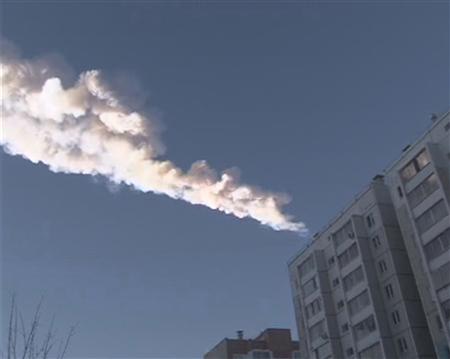
Wild crazy news on the social networks was buzzing about a meteorite crash which injured over 900 in Russia.

As with most things on the social networks, the key is patience to see if they actually are true, or just some viral feed which is false.

Nope. This one was real.

WOW.

As the cops are more corrupt in Russia than those they supposedly protect, everyone has a dashboard cam in their cars, and videos of the 11 metric tonne piece of space rock zooming past at about 54,000 kph (33,000 miles/hour) across the early morning sky were phenomenal.

At about 30-50 km (18-32 miles) above the ground, the pressure from our atmosphere caused the giant space rock to explode in what would have been the equivalent of a nuclear warhead going off above a populated area.
All electronic devices went dark as the radiation from the blast interfered with the Earth’s electro-magnetic field. Slowly electronic devices came back to life, but mobile communications are still being affected as there is still trace amounts of interference in the atmosphere keeping people’s smartphones, GPS, satellite signals, even AM and FM radio station frequencies sporadic at best – as of this writing.
There was one video where it was deathly quiet, as the world was just starting to wake up, only to have that silence literally shattered by a mega-big bang, which startled me as I watched the video. The big bang is followed by several micro bursts and the sounds of glass breaking as windows succumb to the supersonic waves travelling faster than the speed of sound. Car alarms, people in panic, and a rush of sirens can be heard after that.

Tweets at the time echoed people’s thoughts affected by the unexpected visitor from a distant galaxy – that the world was ending.

That’s probably what ran through the dinosaur’s minds as rocky rubble fell from above, as the sky light up ablaze in a fiery burst of light.

Luckily, the space rock wasn’t large enough to cause an Extinction Level Event (ELE) – like the one which killed off dino – but it was large enough to remind us that we’re living in dangerous times.

Although American President Barack Obama is trying to make peace with the yahoo rednecks of the National Rifle Association, as he battles gun control to make his country safe, there are things which are far more dangerous, and even further out of our control than guns.

The Earth – our only place of refuge in the vastness of space – is pummelled by space dust, and meteorites every day. Just the average size of these rocks making it through our atmosphere is no bigger than the tip of your thumb – so we hardly take any notice.

But when a rock the size of small car crashes into the Earth, the world wakes up to the fact that we’re living in a dangerous part of the universe.

We’ve been remarkable lucky over the past 100,000 to 200,000 years – the time frame for when humans first walked on the Earth.
Unlike our predecessors, the dinosaurs, we’ve been quite lucky, considering all the enormous space rocks the size of small planets hurtling through space in all directions.

These fragments left over from the big bang which spawned our universe and form the building blocks for everything within it – including us – continue like billiard balls, rolling through space, colliding with one another all the time.

It’s a mixed blessing of sorts that we haven’t witnessed anything worse than today’s meteorite shower disrupting our world more often. On the one hand, it’s scary as hell – especially when scientists, military experts and academics admit that we currently have no way to defend ourselves from these falling space rocks from the sky.

But from the point of view of an amateur astronomer, it’s so cool to see space science in action. Unlike the other sciences, where you can simply create a hypothesis and test it, theories about the big bang, the early formation of the universe, or even where did we all come from in the first place aren’t nearly so easy to prove.

Putting that thought aside, today’s close call with a meteorite in Russia is an eye opener for us all – because the “wow” and the scary factor win.

I think I’ll go now, and hide under the bed.

Monday, 11 February 2013

Pope’s Resignation Signals the Death of Faith


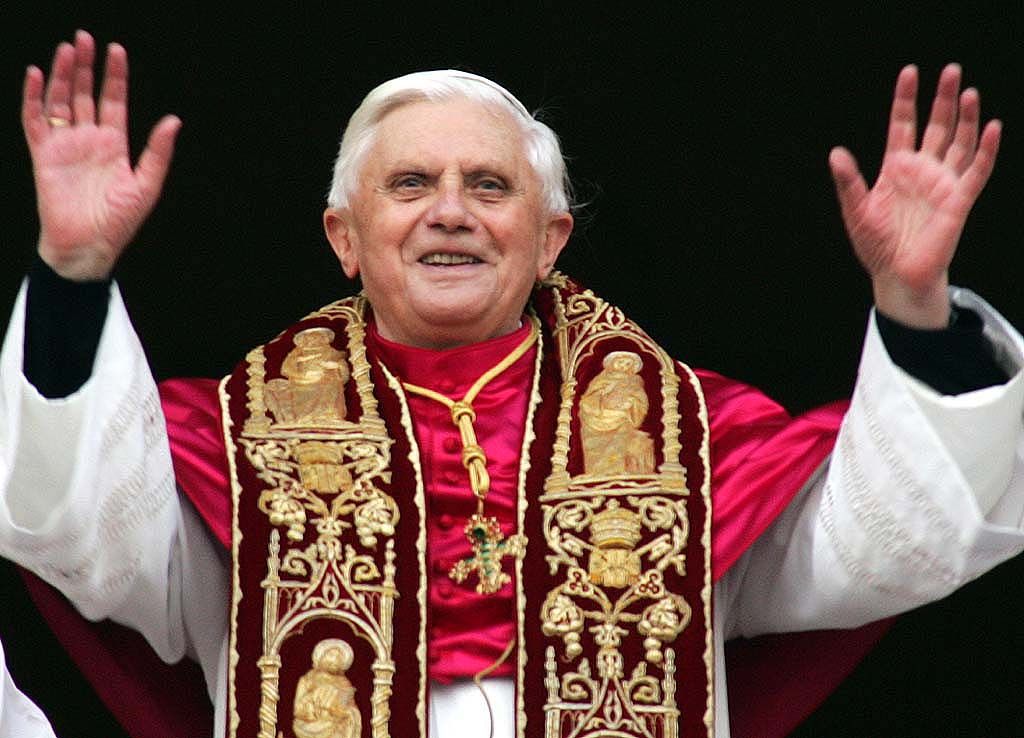
For the first time in over 600 years – and only the second time in history – the leader of the Catholic Church has let his instincts – and not God – determine his faith.

Today, the world’s media is buzzing with news that the 85-year-old Pope Benedict XVI will resign on Feb. 28.

Sighting “advanced age” as just cause to break with traditions, the Pope announced his retirement while most of the western world was asleep.

Organized religion – particularly the Catholic Church – has taken quite a beating over the years. 

As science and technology continues to advance, and we see the world for the way it really is – and not necessarily how our ancestors once thought it was – we are a world which is losing faith.

With the scandalous $2.2 billion the Catholic Church has had to pay to victims of sexual abuse by their clergy, it’s only continued the downward spiral of organized religion even further.

So news of the Pope’s resignation is another blow to the church, and to religion as a whole.

Most Papal leaders don’t chose their own fate – that’s God’s decision – so the only way they retire is literally by death.
Having a Pope decide his own fate, shows a lack in faith by the one person who’s job it is to instill it in others.
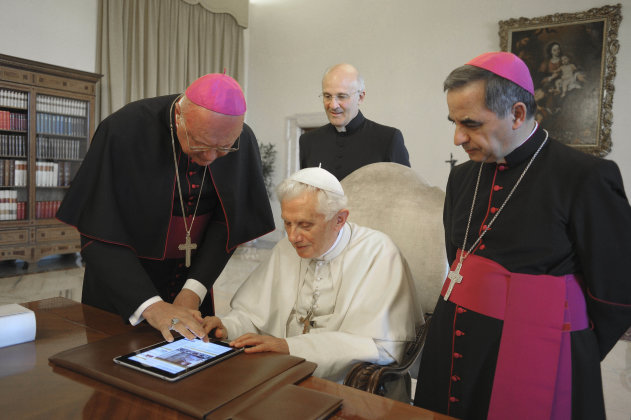
This resignation comes shortly after the Pope began his official Twitter account, and began spreading his religious tweets around the world in numerous languages.

Perhaps the Pope’s own experience with technology has shown him his true age, and in part formed his decision to quit his job so suddenly?

Scientific and technological advances have always clashed with the beliefs of organized religion, yet in the end, it’s the science which has proof to back it’s claims, while religion has always claimed it’s a matter of faith.
From Copernicus that found out the Sun was the centre of the galaxy, not the Earth, as the Catholic Church believed, to Galileo’s first glimpses into the heavens using his own home-made eye-piece – both were banished by the Catholic Church for their scientific discoveries which we know to be true today.

The constant tug-o-war between religious beliefs and scientifically provable theories continues to this day. The whole Right to Life movement sprung forth from religious beliefs about the when a fetus is considered a person, and there is still a controversial movement trying to encourage our public education system to teach we all came from Adam and Eve, not from a Darwin-based theory of evolution, as science as proven.

I remember growing up in the suburbs of Canada’s largest city – Toronto – and every morning, my school day started by reciting the Lord’s Prayer.

I went to a public school, and not being of the Catholic Faith, I never identified with that prayer. I just did it because everyone else did – and being a young kid, I didn’t know any better.

Looking back, I sometimes feel cheated by the very people that taught me to read and write, because they forced their religious beliefs upon me at a time when I was too young to even think of such things. Not that saying the Lord’s Prayer damaged me in some way, but too make it appear a normal part of everyday life for everyone, when it is not, was an abuse of power.
It was only a few years ago that the Lord’s Prayer was officially dropped from the public school system which I went through, as educators finally came to the realization that not everyone believes in the same religion, and maybe there was something unethical in their preaching’s.

Our society continues to evolve and grow as our world becomes smaller, through technology.
Perhaps the time has come for us all to question our faith – and resign our religious beliefs – just as the leader of the Catholic Church did today?

Tuesday, 5 June 2012

Transit of Venus May Answer Age Old Question Where Did I Come From?

Tonight, a rare cosmic phenomenon will occur high up above our heads – Venus’ orbit brings it right in front of our Sun.

Depending on where on this planet you happen to be, you’ll most likely start to see Venus as it transits across Sun from 5:30pm EST. Astronomers call this the Transit of Venus, and it’s a very rare event – miss tonight’s event and you’ll have to wait about 105 years to see it happen again.

But for amateur astronomers like myself, it isn’t just the infrequency of these celestial events which makes them so enticing. Most think of us sky watchers as space geeks. Sci-fi fans that dress like their favorite Star Trek characters, still living at home in their parent’s basements. Awkward in social situations, unless we are talking about string theory, black holes, and Captain Kirk.

Not true.

Well, okay, I enjoy Star Trek, have discussed string theory, black holes and Captain Kirk . . . but the rest is just wrong!

Seriously – astronomy is more than just watching the stars.

Astronomy is all about unraveling the mysteries which human beings have been seeking since we could think. Is there life on other planets? Are there other worlds like our own? And the ultimate question – where did I come from?

Truth is, astronomers know where we all came from, and it doesn’t relate to the birds and the bees. 

We’re all aliens from another world – or more accurately – we’re all composed of the bits and pieces from other worlds, which compose our bodies, making us who and what we are.

A little before you were born – say about 14 billion years ago – there was this Big Bang, which exploded all the elements outwards, into the vacuum of space.

All the basic elements found on the periodic table -- oxygen, hydrogen, helium and the rest – were scattered throughout our universe from that original Big Bang.

As the basic elements collided with each other in clouds of dust and debris, over billions of years of swirling in space, they formed planets, stars, comets, asteroids, meteors, plants, trees, mountain tops and eventually you.

You are composed of the fabric of space – all the elements within your body originated in that cosmic explosion billions of years ago. Now don’t you feel old?

We human beings are composed of carbon, hydrogen, oxygen and a few other basic elements. And all of these elements – even the ones composing our bodies today – originated from that massive explosion billions of years ago.

So when astronomers salivate over rare cosmic events like tonight’s Transit of Venus, we’re not just watching something rare occur – we’re trying to learn more about ourselves, and where we all came from.

Because although we know all matter that exists everywhere anywhere in our universe came from the Big Bang, we still don’t really know where the Big Bang came from.

But by looking up, one day we may figure it all out, and finally answer those questions which we have been asking since we could think – where did I come from?