Showing posts with label Astronomy. Show all posts

Friday, 15 February 2013

Russian Meteorite Fall Out Reminds Us How Violent Our Universe Really Is


Wild crazy news on the social networks was buzzing about a meteorite crash which injured over 900 in Russia.

As with most things on the social networks, the key is patience to see if they actually are true, or just some viral feed which is false.

Nope. This one was real.

WOW.

As the cops are more corrupt in Russia than those they supposedly protect, everyone has a dashboard cam in their cars, and videos of the 11 metric tonne piece of space rock zooming past at about 54,000 kph (33,000 miles/hour) across the early morning sky were phenomenal.

At about 30-50 km (18-32 miles) above the ground, the pressure from our atmosphere caused the giant space rock to explode in what would have been the equivalent of a nuclear warhead going off above a populated area.
All electronic devices went dark as the radiation from the blast interfered with the Earth’s electro-magnetic field. Slowly electronic devices came back to life, but mobile communications are still being affected as there is still trace amounts of interference in the atmosphere keeping people’s smartphones, GPS, satellite signals, even AM and FM radio station frequencies sporadic at best – as of this writing.
There was one video where it was deathly quiet, as the world was just starting to wake up, only to have that silence literally shattered by a mega-big bang, which startled me as I watched the video. The big bang is followed by several micro bursts and the sounds of glass breaking as windows succumb to the supersonic waves travelling faster than the speed of sound. Car alarms, people in panic, and a rush of sirens can be heard after that.

Tweets at the time echoed people’s thoughts affected by the unexpected visitor from a distant galaxy – that the world was ending.

That’s probably what ran through the dinosaur’s minds as rocky rubble fell from above, as the sky light up ablaze in a fiery burst of light.
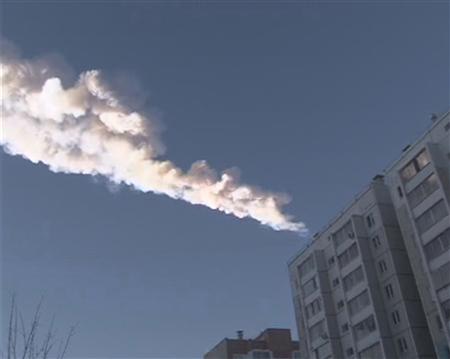
Luckily, the space rock wasn’t large enough to cause an Extinction Level Event (ELE) – like the one which killed off dino – but it was large enough to remind us that we’re living in dangerous times.

Although American President Barack Obama is trying to make peace with the yahoo rednecks of the National Rifle Association, as he battles gun control to make his country safe, there are things which are far more dangerous, and even further out of our control than guns.

The Earth – our only place of refuge in the vastness of space – is pummelled by space dust, and meteorites every day. Just the average size of these rocks making it through our atmosphere is no bigger than the tip of your thumb – so we hardly take any notice.

But when a rock the size of small car crashes into the Earth, the world wakes up to the fact that we’re living in a dangerous part of the universe.

We’ve been remarkable lucky over the past 100,000 to 200,000 years – the time frame for when humans first walked on the Earth.
Unlike our predecessors, the dinosaurs, we’ve been quite lucky, considering all the enormous space rocks the size of small planets hurtling through space in all directions.

These fragments left over from the big bang which spawned our universe and form the building blocks for everything within it – including us – continue like billiard balls, rolling through space, colliding with one another all the time.

It’s a mixed blessing of sorts that we haven’t witnessed anything worse than today’s meteorite shower disrupting our world more often. On the one hand, it’s scary as hell – especially when scientists, military experts and academics admit that we currently have no way to defend ourselves from these falling space rocks from the sky.

But from the point of view of an amateur astronomer, it’s so cool to see space science in action. Unlike the other sciences, where you can simply create a hypothesis and test it, theories about the big bang, the early formation of the universe, or even where did we all come from in the first place aren’t nearly so easy to prove.

Putting that thought aside, today’s close call with a meteorite in Russia is an eye opener for us all – because the “wow” and the scary factor win.

I think I’ll go now, and hide under the bed.

Tuesday, 3 July 2012

Intelligent Life Outside Planet Earth?

What if there is intelligent life outside of our own solar system?

The ancient Greek Philosophers thought the skies above were the heavens, and the sun, stars, winds, rain and just about everything else, came from various gods.

Thanks to technology, we now know that the sun rise and set isn’t controlled by Zeus, Apollo, or some other god-like being, but is just the natural course of planetary orbits within our solar system.

The real question scientists and sci-fi aficionados have been seeking to solve, is whether there really are other intelligent life forms.

Movie makers have long used this question to entertain us, creating a whole genre of films featuring the stereotypical olive-green men from Mars, with those scary dark as night eyes, long faces, and just as creepily long arms and legs. Sadly, most of these movies are so bad, they shouldn’t even qualify for their “B-Movie” labels.

But the question I started thinking about wasn’t whether intelligent life exists outside of our safe and comfortable home of planet Earth. My thoughts turned to the infamous “what if?”

What if we do discover intelligent beings, able to communicate with us? What then?

We have enough difficulty communicating with ourselves, with all the wars going on around the globe. Some of us can’t talk to our own boss, wife, or even to our kids without getting all tongue-tied.
How would we relate to beings from another world?
 
Would we be open to sharing our socio-economic and technical knowledge? Would they?

Assuming there are beings intelligent enough to visit us – as we certainly haven’t mastered space travel yet – they would probably be far more advanced than us.

Maybe they have solved all of the common global crisis we face now – war, starvation, famine, drought, holes in the ozone, global warming . . .

It would be an amazing bit of luck to pick the brains of some alien race, who could solve all – or even just one – of these problems.

But then again, what could we offer in return?

Here, have a cheese doodle.

Yeah. Right.

Chances are, if aliens were able to solve the distances of space travel to visit it us, we’d be so far beneath them on the evolutionary scale, we may seem like cockroaches appear to us.

And for the most part, we crush cockroaches, as we just see them as filthy, disgusting insects that invade our homes scavenging for food.

One of the greatest minds in our time, Stephen Hawking even suggested not long ago, that we should stop sending out signals, satellites, and other spacecraft in search of alien life, because it puts us at grave risk.

To Hawking, sending out these beacons is like showing the insect exterminator where the hive is. We human beings haven’t exactly been all that peaceful with others from distant lands down here on Earth – just think of all the wars and currently and previously being fought.

What makes us so sure aliens able to travel to other worlds would be any different?

Our planet is a wealth of natural resources, ripe for the picking of any alien species which might use it for food, fuel or a new home.

And if they have mastered space travel, they certainly have the technological power to displace and destroy us as they harvest our planet’s resources, or make themselves home.

Wednesday, 6 June 2012

Social Media Brings Space Exploration Home

Last night, along with every other amateur astronomer, and many just curious to see what all the fuss was about, I watched the Transit of Venus.

A rare event, Venus’ orbit crossed in front of our Sun, making the far away celestial body appear as a black dot crossing the giant glowing orange of our Sun.

As Venus “transits” across the Sun (hence the event’s name), it gives astronomers a rare chance to study it, our Sun, and learn a bit more about our Solar System, our universe, and ultimately ourselves.

However cool it was to watch this rare event – the next Transit of Venus won’t occur for 105 years – what was way cooler was the ability to watch it from observatories around the world simultaneously.

Not long ago, watching cosmic events meant heading to your local observatory, or breaking out your best telescope and in both instances, hoping for a clear sky, while waiting alone, for hours to catch glimpse of what usually lasted mere minutes.

Thanks to the Internet and social media, I was sitting in the comfort of my own home, in front of my computer, watching amazing images being broadcast from observatories in Canada, Europe, Asia, and the United States – all at the same time, and all with unique perspectives and commentary from those watching along with me.

When we think of space exploration, we think of the vastness of the galaxy, and how far everything is. The closest any planet gets to us is Venus, at 38 million kilometers – but it’s orbit takes it as far as 261 million kilometers away. Today’s technology could launch a rocket, and it would take about four months before it reached Venus. That’s no short trip to the corner store.

However, social media makes the mind numbing distances of space exploration disappear, as looking up and watching the sky need not be an isolated event, by a handful of geeks gathering in a farmer’s field during the wee hours of the morning.

It was a wonderful experience being able to chat with other people around the world, as we watched a special event. We all shared in the awe of this event, and when clouds passed in front of one observatory, we all joked and laughed together, as we talked about the other observatory feeds.

For many, social media is purely about promoting their own business or cause. But last night, the real meaning of social media was very – human – the sharing of an experience.

And what an experience it was.

Tuesday, 5 June 2012

Transit of Venus May Answer Age Old Question Where Did I Come From?

Tonight, a rare cosmic phenomenon will occur high up above our heads – Venus’ orbit brings it right in front of our Sun.

Depending on where on this planet you happen to be, you’ll most likely start to see Venus as it transits across Sun from 5:30pm EST. Astronomers call this the Transit of Venus, and it’s a very rare event – miss tonight’s event and you’ll have to wait about 105 years to see it happen again.

But for amateur astronomers like myself, it isn’t just the infrequency of these celestial events which makes them so enticing. Most think of us sky watchers as space geeks. Sci-fi fans that dress like their favorite Star Trek characters, still living at home in their parent’s basements. Awkward in social situations, unless we are talking about string theory, black holes, and Captain Kirk.

Not true.

Well, okay, I enjoy Star Trek, have discussed string theory, black holes and Captain Kirk . . . but the rest is just wrong!

Seriously – astronomy is more than just watching the stars.

Astronomy is all about unraveling the mysteries which human beings have been seeking since we could think. Is there life on other planets? Are there other worlds like our own? And the ultimate question – where did I come from?

Truth is, astronomers know where we all came from, and it doesn’t relate to the birds and the bees. 

We’re all aliens from another world – or more accurately – we’re all composed of the bits and pieces from other worlds, which compose our bodies, making us who and what we are.

A little before you were born – say about 14 billion years ago – there was this Big Bang, which exploded all the elements outwards, into the vacuum of space.

All the basic elements found on the periodic table -- oxygen, hydrogen, helium and the rest – were scattered throughout our universe from that original Big Bang.

As the basic elements collided with each other in clouds of dust and debris, over billions of years of swirling in space, they formed planets, stars, comets, asteroids, meteors, plants, trees, mountain tops and eventually you.

You are composed of the fabric of space – all the elements within your body originated in that cosmic explosion billions of years ago. Now don’t you feel old?

We human beings are composed of carbon, hydrogen, oxygen and a few other basic elements. And all of these elements – even the ones composing our bodies today – originated from that massive explosion billions of years ago.

So when astronomers salivate over rare cosmic events like tonight’s Transit of Venus, we’re not just watching something rare occur – we’re trying to learn more about ourselves, and where we all came from.

Because although we know all matter that exists everywhere anywhere in our universe came from the Big Bang, we still don’t really know where the Big Bang came from.

But by looking up, one day we may figure it all out, and finally answer those questions which we have been asking since we could think – where did I come from?