My age was showing, but I was glowing, as I
reminisced about days of old with a couple younger colleagues today.

We were discussing desktop publishing,
layout and design, and we were discussing the various software applications
people use in this field, when one of my colleagues asked what ever happened to
Adobe Pagemaker.
Ah, Pagemaker, that takes me back to days
long before computers were popular for layout and design. Incidentally, Adobe
Pagemaker was morphed into Adobe’s Creative Suite (CS) and became Adobe InDesign.
But my mind began to wander, as I described
the old days of layout and design. Back then, the tools of the trade were
anything but high tech. Cork cutting boards, X-Acto knives, rulers, scissors,
rollers and burning, BURNING hot wax littered the layout and designer’s desks.
Many times I’d burn myself on the hot wax,
rushing to paste together a story in time for a print run. Luckily it was like
a candle burn, nothing major.
Back then, printed pages were literally cut
and pasted together on long wax coated pages called “proofs.” Hot wax was
rolled onto these proofs, and each story was cut into pieces, and each piece
was coated in this hot wax. The wax would allow you to slide each bit into the
perfect spot in the layout, creating a page in the newspaper. Then the pages
were hung like freshly washed clothes to dry.
 It was a time consuming process, requiring steady
hands, and a solid eye for being able to see when things were aligned just
right. The most skilled at this could eyeball a single line of type (say a
headline) without a ruler, and just know when it was perfectly straight on the
page.
It was a time consuming process, requiring steady
hands, and a solid eye for being able to see when things were aligned just
right. The most skilled at this could eyeball a single line of type (say a
headline) without a ruler, and just know when it was perfectly straight on the
page.
Though each proof came with pastel pink and
blue grid lines, showing you the way.
To reduce some of the repetitive tasks of
this time consuming process, layout designers kept many common elements on the
side of their desks ready to go. The “paste-up board” as it was often called,
because it had elements (such as page identifiers, logos, staff by-lines,
datelines, place lines and so on) were all lying there, pre-sized and waiting
to be pasted-up onto the page.
The area surrounding your pages in most
desktop layout design applications is still called the paste-up board today,
and is used to story common elements which can be copied into place.
 These completed waxed pages would then be
sent to the printers, where they would take them and create plates which they’d
use for a print run.
These completed waxed pages would then be
sent to the printers, where they would take them and create plates which they’d
use for a print run.
When breaking news occurred, the poor
layout designer literally had to start from scratch, because nothing was
electronically designed, so the page or pages affected by the new story had to
be recreated.
This is was why deadlines were so very important
back in those days, as a breaking news story could delay the print run of a
newspaper for hours.
Once a print run begins, it takes some time
to get started again, because of the way inks are printed in layers at
different stages to achieve different colors and effects. So it still takes
time to stop and start the actual production of a paper.
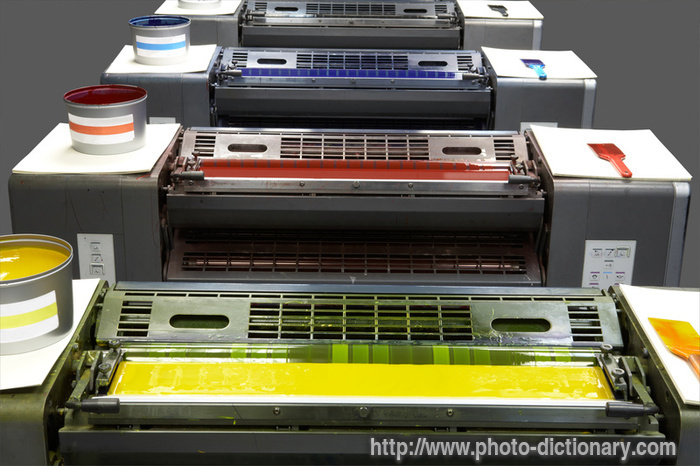 That’s why most major daily papers have two
or three print runs, say a morning, afternoon and evening run. Some even have
different edition runs, say one for the city, and one for distribution outside
the city in the suburbs. If a breaking story changes the paper, they will toss
the revised story into the next print run, instead of stopping the presses
completely.
That’s why most major daily papers have two
or three print runs, say a morning, afternoon and evening run. Some even have
different edition runs, say one for the city, and one for distribution outside
the city in the suburbs. If a breaking story changes the paper, they will toss
the revised story into the next print run, instead of stopping the presses
completely.
This is partially why newspapers are dying.
Often, by the time they have hit newsstands, many of the stories are already
out of date.
With 24-hour, seven-day-per-week news
channels on television and radio, and with the global reach of the always on
Internet, developing news stories change constantly. Newspapers can’t change
once printed.
 The always on digital media also has
driven us to expect news to be new the second we see it. When you read
something in a newspaper, it was current at the time it was written.
The always on digital media also has
driven us to expect news to be new the second we see it. When you read
something in a newspaper, it was current at the time it was written.
And newspapers take so much time to read, while
television, radio, even the Internet can broadcast the news to us bringing us
up-to-speed in minutes.
Although newspapers are a dying breed, I
miss the old days of the hot wax, Xacto Knives, and paste-up boards. Back then,
laying out a page was a much more hands-on process, because you physically
placed stories on the page. These days, you point, click and drag your stories
into place.
It just doesn’t have the same feel.

No comments:
Post a Comment
Thank you kindly for your feedback! All comments are reviewed prior to posting.